
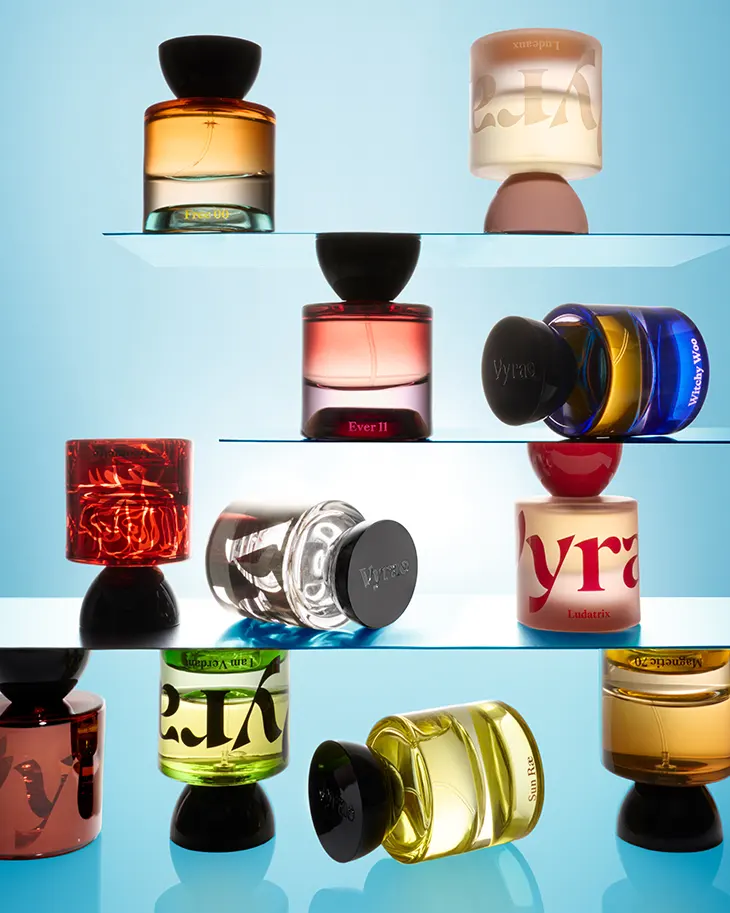
The acquisition of Vyrao by Tresalis, a newly established owner-operator platform, arrives at a telling moment in luxury beauty. That a London-founded neuroscent brand, barely five years old, was acquired not by L’Oréal, Estée Lauder, or any of the multinational giants that typically consolidate emerging luxury brands, but instead by a Munich-anchored family office and serial entrepreneur, says something important about how the market has shifted.
For decades, the acquisition playbook was straightforward: an independent beauty or fragrance brand achieved critical momentum and consumer recognition, and a major conglomerate absorbed it into a portfolio, leveraging distribution muscle and operational scale to drive growth. The brand retained its identity in name only; creative direction, ingredient sourcing, and strategic vision were filtered through corporate infrastructure designed to optimize for margin and market reach.
Vyrao’s acquisition by Tresalis, and the platform’s deliberate decision to retain Yasmin Sewell as Chief Brand Officer with creative and strategic autonomy, represents a different thesis entirely. It assumes that in a market increasingly saturated with legacy luxury and increasingly skeptical of conglomerate marketing, a brand’s competitive advantage lies not in distribution infrastructure or manufacturing scale, but in authentic differentiation and editorial credibility.
Science-Led Beauty Moment
Vyrao emerged in a fragrance landscape experiencing genuine fracture. On one end: the mega-brands churning out flankers and celebrity collaborations. On the other: a growing cohort of consumers demanding transparency, efficacy claims backed by research, and a philosophical coherence between what a brand claims and how it operates.
Sewell’s background, reiki practitioner, Ayurveda-trained, luxury retail creative director, gave Vyrao something most fragrance houses lack: a legitimate intellectual framework. The brand wasn’t simply slapping wellness language onto fragrance; it was building fragrance around neuroscience research into ingredient effects, partnering with IFF’s Science of Wellness program to document mood-enhancing properties. Each release, from The Sixth through Ever 11, was positioned as a targeted emotional intervention, not a lifestyle accessory.
That positioning proved resonant. Vyrao secured placement at Liberty London, Harvey Nichols, Revolve, and Goop, retailers that curate carefully and reject brands that don’t align with their editorial voice. Within five years, the brand achieved global distribution without a conglomerate’s machinery. It did so through coherence, not scale.
Why Tresalis, Not L’Oréal
The conventional reading of this acquisition is straightforward: Vyrao needed capital and operational infrastructure to accelerate growth, and Tresalis provided it. But the more interesting question is why L’Oréal or Estée Lauder didn’t acquire Vyrao first.
The answer reveals something uncomfortable about how legacy conglomerates operate. A brand like Vyrao represents both opportunity and threat to a multinational portfolio house. The opportunity is obvious: a differentiated, credible wellness fragrance with proven retail traction and a loyal consumer base. The threat is subtler: integrating Vyrao into a conglomerate’s operational and financial structure inevitably compromises the very qualities that made it valuable.
L’Oréal’s acquisition model typically involves inserting brands into category-specific divisions, rationalizing supply chains, optimizing for margin targets, and applying marketing playbooks developed for far larger brands. This approach works for scaling mass-market products; it devastates niche brands built on differentiation and founder vision.
Moreover, legacy conglomerates move slowly. A brand like Vyrao, operating at the intersection of fragrance, neuroscience, and wellness, requires agility. It requires decision-making that prioritizes editorial coherence and brand authenticity over quarterly earnings targets. It requires the ability to pivot quickly, to say no to lucrative partnerships that don’t align with brand values, and to invest in long-term positioning over short-term margin extraction.
Tresalis, by contrast, was built for exactly this moment. Dr. Fernando Tamez, with his track record as a serial entrepreneur in health and beauty, understands that science-led brands operate differently. ATHOS, a family office, brings patient capital uninterested in extracting returns within a three-to-five-year window. The platform model itself, acquiring and growing multiple differentiated brands while preserving their distinct identities and operational autonomy, is antithetical to the conglomerate playbook.
Founder Retention Question
That Sewell remains as Chief Brand Officer with meaningful equity and creative autonomy is not incidental to this acquisition; it is the acquisition’s entire thesis.
When conglomerates acquire founder-led brands, founder retention typically lasts eighteen to thirty-six months. The arrangement satisfies investors (continuity during transition), assuages press and consumer concerns (founder still involved), and provides a graceful exit for the founder. But the founder’s actual authority diminishes steadily. Strategic decisions get filtered through corporate governance. Creative direction gets tested against brand guidelines developed for ten other luxury houses. Eventually, the founder departs, and the brand becomes what it was always going to become: another portfolio asset.
Tresalis’s structure inverts this dynamic. Sewell’s role as Chief Brand Officer isn’t ceremonial; it’s foundational. She is not answerable to a category president at a multinational conglomerate, but rather to a platform designed to amplify precisely the qualities that distinguish her brand. This operational model requires trust, in Sewell’s creative judgment, in the brand’s philosophical coherence, in the idea that long-term value accrues to brands that refuse to compromise their positioning for short-term growth.
Whether this trust proves justified will be revealed over time. But the structural incentive alignment is radically different from the conglomerate model.
Broader Implications for Science-Led Beauty
Vyrao’s acquisition by Tresalis is not an outlier. Across beauty and wellness, we are seeing similar moves: founder-led, science-grounded brands pairing with specialized platforms or family offices rather than waiting for acquisition offers from multinational conglomerates.
This shift reflects several converging realities. First: consumers are increasingly discerning about which brands deserve their allegiance. In a market saturated with conglomerate-owned brands, a brand’s independence and editorial credibility have become competitive advantages. Second: digital distribution and direct-to-consumer channels have reduced the distribution moat that once made conglomerate ownership essential. A brand with authentic positioning and loyal consumers can reach customers globally without needing a multinational sales force. Third: the conglomerate model itself is experiencing legitimacy challenges. Consumers increasingly scrutinize the ethics, sustainability, and authenticity claims of mega-brands and are voting with their wallets for alternatives.
For science-led beauty specifically, the moment is acute. A brand built on neurological efficacy claims, clean formulations, and holistic wellness cannot credibly operate under the same roof as beauty conglomerates historically built on opacity, margin extraction, and marketing smoke. The positioning is fundamentally incompatible.
What Tresalis Enables, And What It Doesn’t Solve
To be clear about what Tresalis offers: genuine operational leverage. The platform brings clinical expertise, international distribution experience, supply chain optimization, and financial resources that an independent brand cannot easily access. For a brand like Vyrao, which has proven consumer resonance but limited operational infrastructure, these resources are genuinely valuable.


What Tresalis cannot automatically solve: the challenge of scaling a premium, differentiated brand without eroding what made it differentiated in the first place. This tension is eternal in luxury. Vyrao’s experiential work—such as the AMO pop-up in Soho, succeeds precisely because it is boutique, curated, and reflective of Sewell’s distinct sensibility. Scale those experiences without diluting them, and you enter murky terrain.
Similarly, Vyrao’s retail positioning at Liberty, Space NK, and Goop works because those retailers are selective. They curate. Expand distribution too aggressively, pushing Vyrao into mass-market channels or expanding retail partnerships beyond what the brand’s editorial identity can sustain, and the brand risks commodification. Tresalis’s success will ultimately depend on its willingness to constrain growth in service of authenticity, a discipline that does not come naturally to acquisition-driven platforms.
The Questions Worth Asking
As Vyrao enters this new chapter, several questions merit scrutiny from observers:
On product strategy: Will Tresalis’s operational resources accelerate innovation in ways that strengthen Vyrao’s positioning, or will they push toward category expansion that dilutes the brand’s core identity? The move into body care cream scents is promising – it extends the neuroscent philosophy into new formats rather than chasing trend-driven adjacencies. But the platform’s first major strategic move will signal its actual philosophy.
On distribution: Tresalis will inevitably seek international expansion, particularly in Asia-Pacific markets where wellness and science-led beauty are thriving. The question is whether that expansion will preserve Vyrao’s positioning as a curated, premium offering or transform it into a globally distributed luxury brand accessible everywhere. These are not necessarily contradictory, but they require disciplined strategic thinking.
On founder influence: Sewell’s retention as Chief Brand Officer is laudable, but founder retention structures are fragile. They depend on alignment between founder and platform leadership, on the platform’s willingness to honorr founder vision even when it conflicts with financial targets, and on founder autonomy over creative and strategic decisions. These relationships are stress-tested when a brand encounters inevitable challenges, product failures, retail setbacks, market shifts.
Conglomerate Reckoning
Finallz, Vyrao’s acquisition by Tresalis is, ultimately, a vote of no-confidence in the conglomerate model’s ability to nurture science-led, founder-driven beauty brands. L’Oréal and Estée Lauder built their empires in an era when distribution was scarce, consumer information was limited, and brand loyalty followed predictable patterns. They remain formidable operators within that context.
But the market has shifted. Consumers now have direct access to information about ingredients, efficacy claims, and brand values. Digital channels have democratized distribution. And founder-led brands, operating with clarity and coherence, can achieve scale without sacrificing authenticity.
Tresalis represents an alternative thesis: that patient capital, specialized operational expertise, and respect for founder vision can outperform the conglomerate playbook. Whether Tresalis proves this thesis or simply replicates conglomerate dynamics at a smaller scale will become apparent over the next three to five years. Until then, Vyrao’s acquisition serves as a data point in a larger reconfiguration of how premium beauty brands scale, and who gets to own them.
